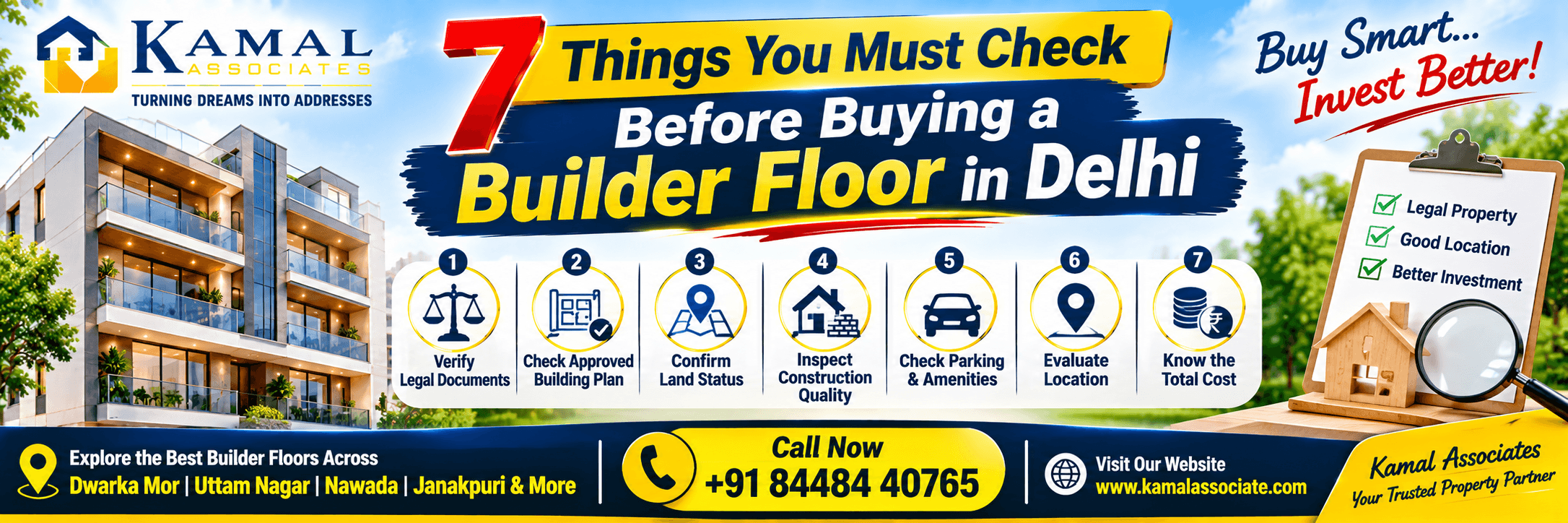
7 Things You Must Check Before Buying a Builder Floor in Delhi
Planning to buy a builder floor in Delhi? Discover 7 essential checks covering legal documents, building approvals, construction quality, parking, location, and total costs before buying.
Buying a builder floor in Delhi can be a smart choice for homebuyers who want independent living, more privacy, and flexibility compared with living in a large apartment society. Areas such as Dwarka Mor, Uttam Nagar, Nawada, Janakpuri, and Vikaspuri offer different types of builder floors across various budgets.
However, buying a builder floor requires careful attention. Two properties may look similar from the outside but differ significantly in ownership documents, construction quality, approved plans, parking rights, and future resale potential.
A small mistake during the buying process can lead to legal complications, unexpected expenses, or difficulties when selling the property later.
Before paying a booking amount or token money, here are seven important things you must check before buying a builder floor in Delhi.
1. Verify the Property Ownership and Legal Documents
The first and most important step is to confirm that the seller has the legal right to sell the property.
Never rely only on verbal promises or photocopies of documents. Ask the seller to provide the relevant ownership papers and get them checked by an experienced property lawyer.
Important documents to verify include:
Sale Deed or Conveyance Deed: Confirms the ownership and legal transfer of the property.
Previous Ownership Documents: Helps establish the chain of ownership.
Seller's Identity Proof: Confirms the identity of the person selling the property.
Mutation or Relevant Property Records: Check applicable municipal or revenue records.
Power of Attorney: If someone is acting on behalf of the owner, verify the authority and its legal scope.
Make sure all owners or legally authorised parties are involved in the transaction. If the property has multiple owners, confirm that everyone whose consent or signature is legally required is included.
Pro Tip: Ask a property lawyer to examine the ownership chain and verify the documents through the relevant registration and revenue records before making a major payment.
2. Check the Approved Building Plan and Construction Permissions
A beautiful-looking building does not automatically mean that its construction is legally approved.
Before purchasing a builder floor, ask for the sanctioned building plan issued by the relevant local authority, such as the Municipal Corporation of Delhi (MCD), where applicable.
Compare the approved plan with the actual construction.
Check the following:
Whether the number of floors matches the approved plan.
Whether the covered area and building layout are consistent with the approval.
Whether balconies, staircases, and common areas match the sanctioned plan.
Whether parking arrangements follow the approved layout.
Whether any additional rooms or structures have been constructed without the required approval.
You should also ask about the applicable completion or occupancy certificate and whether any deviations have been regularised, where permitted.
Unauthorised construction can create problems with financing, utilities, resale, and action by the relevant authorities.
Pro Tip: Do not depend only on the builder's floor plan or brochure. Ask for the official approved plan and have it checked by a qualified professional.
3. Confirm the Land Status and Colony Legality
In Delhi, checking the status of the land and the colony is an important part of property verification.
Some properties may be located in authorised colonies, while others may have different land or regularisation-related conditions. The documentation requirements can vary depending on the location and ownership history.
Before buying, check:
Whether the property is situated in an authorised colony or has a specific regularisation status.
Whether the land is freehold or leasehold.
Whether the required conversion or conveyance documents are available.
Whether any land-use restrictions or conditions apply.
Whether the property has unresolved ownership or land-related disputes.
If the property is leasehold, ask about the lease conditions and whether the required permissions or transfer formalities have been completed.
For properties in areas with special land arrangements, including certain village or Lal Dora areas, take independent legal advice instead of assuming that the documents are identical to those of a regular freehold property.
Pro Tip: Never assume that a property is legally clear simply because it has been occupied for many years. Verify its land status and ownership documents independently.
4. Inspect Construction Quality and Building Safety
Construction quality directly affects your comfort, safety, and future maintenance expenses.
A builder floor may look attractive during the first visit, but hidden construction problems can become expensive after possession.
During your property inspection, pay attention to:
Walls and Plaster: Look for cracks, damp patches, and uneven finishing.
Roof and Ceiling: Check for leakage, seepage, and water stains.
Flooring: Inspect tiles, marble, and floor levels.
Electrical Wiring: Check the quality of switches, wiring, distribution boards, and electrical load arrangements.
Plumbing: Test taps, drainage, water pressure, and bathroom fittings.
Windows and Doors: Check their quality, locking systems, and ventilation.
Staircase and Common Areas: Ensure that access is safe and convenient.
If possible, visit the property after rainfall or ask about previous seepage and leakage complaints.
For a newly constructed building, consider getting an independent civil engineer or building inspector to assess the structure and visible construction quality.
Pro Tip: Do not finalise a property based only on its interior design. Good construction and proper maintenance are more important in the long run.
5. Verify Parking, Lift, Terrace, and Other Facilities
Amenities can make a major difference in your daily lifestyle, especially when buying a builder floor in a multi-storey building.
However, it is important to distinguish between facilities that are physically available and rights that are legally included in your purchase.
Check the following:
Parking:
Is dedicated parking available for your floor?
Is the parking space clearly identified in the relevant documents?
Is there enough space for your vehicle?
Is the parking arrangement consistent with the approved plan?
Lift:
Is a lift installed and operational?
Is there a maintenance arrangement?
Who is responsible for electricity and repair expenses?
Is the lift included in the approved building arrangements, where applicable?
Terrace and Roof Rights:
Does the top-floor purchase include any exclusive terrace rights?
Are those rights clearly mentioned in the registered documents?
Are there restrictions on construction or future use?
Other Facilities:
Water supply and storage arrangements.
Electricity meter arrangements.
CCTV and security, if provided.
Common staircase and entrance maintenance.
Rainwater drainage and waste disposal.
Never accept statements such as "parking is yours" or "the terrace belongs to you" without checking the legal documents.
Pro Tip: Make sure the rights related to parking, terrace, common areas, and land share are clearly recorded in the sale documents wherever applicable.
6. Check the Location, Connectivity, and Nearby Facilities
A property is not valuable only because of its size or interior design. Its location also plays an important role in daily convenience and future resale demand.
Before buying, visit the area at different times of the day and understand the surroundings.
For buyers considering West Delhi, locations such as Dwarka Mor, Uttam Nagar, Nawada, Janakpuri, and Vikaspuri offer different connectivity and neighbourhood options.
Evaluate these factors:
Metro Connectivity: Check the actual distance from the nearest metro station.
Road Access: Understand the condition of connecting roads and traffic.
Schools and Colleges: Check nearby educational institutions.
Hospitals: Identify accessible healthcare facilities.
Markets: Look for grocery stores, shopping areas, and daily-need shops.
Public Transport: Check buses, autos, and other transport options.
Neighbourhood: Observe cleanliness, safety, drainage, and surrounding construction.
Do not depend entirely on the distance mentioned in an online listing. Visit the property and measure the actual travel distance and time.
Also consider whether the location suits your family's daily routine, workplace commute, and long-term requirements.
Pro Tip: A well-connected property with essential facilities nearby can be more practical than a larger home in a location that does not suit your lifestyle.
7. Understand the Total Cost, Payment Terms, and Registration Process
The advertised property price is not always the final amount you will spend.
Before confirming the deal, calculate the complete purchase cost and understand every payment obligation.
Consider these expenses:
Property purchase price.
Stamp duty and registration charges.
Brokerage, if applicable.
Legal verification fees.
Home loan processing and related charges, if applicable.
Electricity and water connection charges, where applicable.
Maintenance or common-area expenses.
Any outstanding property tax or utility dues that need to be settled.
Ask the seller for the latest available property tax and utility payment receipts. Also check whether the property has an existing loan or mortgage and what steps are required to clear it before or during the transaction.
For payments, use traceable banking methods such as NEFT, RTGS, or cheque and obtain proper receipts. Avoid paying large amounts in cash or transferring money to an unrelated personal account.
Finally, ensure that the sale deed is properly prepared, executed, and registered with the concerned Sub-Registrar. After registration, check the applicable mutation process.
The Delhi Revenue Department provides information about property registration and online searches of past registration details. Verify the applicable stamp duty and registration charges at the time of your transaction.
Pro Tip: Ask for a written payment schedule and do not transfer the full amount before the required legal and registration formalities are properly addressed.
Bonus: Common Mistakes to Avoid When Buying a Builder Floor
Even experienced buyers can overlook important details when they are in a hurry to finalise a property.
Avoid these common mistakes:
Paying token money without checking ownership documents.
Ignoring the sanctioned building plan.
Not verifying the land's freehold or leasehold status.
Assuming that parking or terrace rights are automatically included.
Ignoring seepage, electrical, and plumbing problems.
Not checking outstanding loans or property dues.
Relying only on verbal promises from the seller or broker.
Not calculating registration and other additional expenses.
Skipping independent legal verification.
Making a decision without visiting the neighbourhood.
Remember, a property purchase is a major financial commitment. Taking a little extra time for verification can help you avoid significant problems later.
Why Choose the Right Property Consultant?
Finding a suitable builder floor involves more than comparing prices and looking at photographs. Buyers need to understand the location, construction quality, available facilities, documentation, and overall suitability of the property.
A reliable property consultant can help you:
Explore suitable 2BHK and 3BHK builder floors.
Compare properties across different locations.
Understand the available amenities and property specifications.
Coordinate property visits.
Understand the documents that require legal verification.
Get assistance during the buying and registration process.
At Kamal Associates, we help property buyers explore residential options in Dwarka Mor, Uttam Nagar, Nawada, Janakpuri, Vikaspuri, and nearby areas of West Delhi.
Whether you are searching for a ready-to-move 2BHK or 3BHK builder floor, our aim is to help you find a property that matches your budget, location preference, and family requirements.
Frequently Asked Questions (FAQs)
1. What documents should I check before buying a builder floor in Delhi?
Check the sale deed, previous ownership documents, seller's identity and authority, sanctioned building plan, applicable completion or occupancy documents, land-status papers, and relevant tax and utility receipts. Have a property lawyer verify the complete set.
2. Is it necessary to check the sanctioned building plan?
Yes. The sanctioned plan helps you verify whether the actual construction matches the approved layout and applicable building permissions.
3. Does a builder floor automatically come with terrace rights?
No. Terrace or roof rights should not be assumed. Check the registered sale documents and relevant property agreements to understand what rights are actually being transferred.
4. How can I check whether a builder floor has an existing loan?
Ask the seller for relevant loan and lender documents, and arrange an independent legal and encumbrance check. A lawyer can also advise on the appropriate searches and clearances before registration.
5. Is buying a builder floor in Dwarka Mor a good option?
Dwarka Mor may be worth considering for buyers looking for residential options in West Delhi, particularly those who value metro connectivity and access to nearby markets. However, the right choice depends on the individual property's legal status, construction quality, price, and location.
6. Should I hire a lawyer before purchasing a builder floor?
Yes. Independent legal verification is strongly recommended before paying a substantial amount or signing the final sale documents.
Conclusion
Buying a builder floor in Delhi can be a rewarding decision when you choose the right property and complete all necessary checks.
Always verify ownership documents, building approvals, land status, construction quality, amenities, location, and total purchase expenses before making your final decision.
Do not make a purchase simply because a property looks attractive or the seller is offering a limited-time deal. A carefully verified property can give you greater confidence and help reduce the risk of future complications.
Looking for a 2BHK or 3BHK builder floor in West Delhi?
Connect with Kamal Associates to explore available residential properties in Dwarka Mor, Uttam Nagar, Nawada, Janakpuri, and nearby locations.
Kamal Associates – Turning Dreams Into Addresses
📞 Call Now: +91 84484 40765
🌐 Website: https://www.kamalassociate.com/
Related Articles

How to Find the Best Property Under ₹50 Lakh in West Delhi
Looking for a property under ₹50 lakh in West Delhi? Explore affordable homes in Dwarka Mor, Uttam Nagar and Nawada. Learn about prices, locations and important buying checks.

Is Dwarka Mor the Next Big Property Investment Destination in West Delhi?
Discover why Dwarka Mor is attracting property buyers in 2026. Explore metro connectivity, 2BHK and 3BHK builder floors, rental opportunities, property prices, and investment potential in West Delhi.

Why Smart Investors Are Choosing West Delhi Over Gurgaon in 2026
Discover why investors are exploring West Delhi over Gurgaon in 2026. Compare property prices, metro connectivity, rental demand, ready-to-move homes, and investment opportunities.