How Infrastructure Projects Increase Property Value
Learn how metro, roads, transport and infrastructure projects can impact property value, rental demand and resale potential in West Delhi.
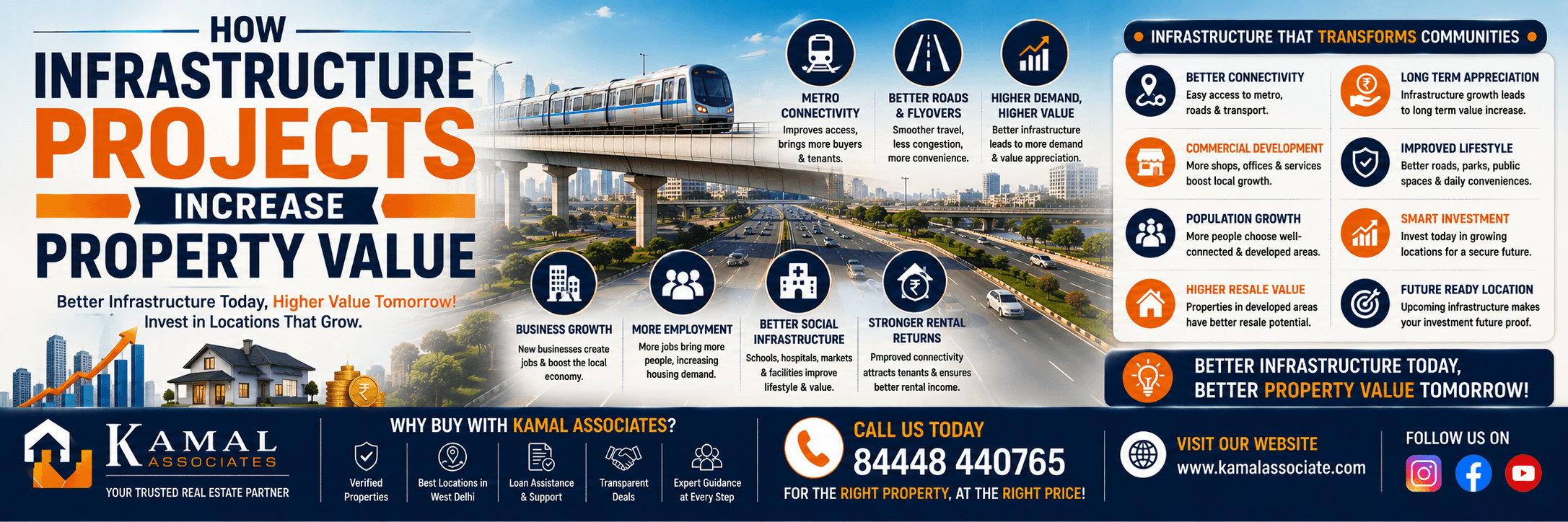
Infrastructure development is one of the most important factors that can influence the demand and long-term attractiveness of real estate.
When new metro connectivity, roads, flyovers, commercial centres, hospitals, schools or other major infrastructure projects are developed around a locality, the area can become more accessible and convenient. This may increase buyer and tenant interest, which can influence property prices over time.
For buyers and investors looking at West Delhi real estate, understanding the relationship between infrastructure and property value can help in making more informed decisions.
1. Better Connectivity Attracts More Buyers
Connectivity is one of the first things property buyers consider.
Infrastructure projects that improve access to:
Metro stations
Main roads
Highways
Flyovers
Public transport
Business districts
Commercial areas
can make a locality more convenient.
A property that was previously difficult to access may become significantly more attractive after connectivity improves.
Why does this matter?
When travel becomes easier, more people may consider living or investing in the area.
This can increase demand for residential properties such as 2BHK flats, 3BHK flats and builder floors in West Delhi.
2. Metro Projects Can Influence Property Demand
Metro connectivity is particularly important in Delhi NCR.
People often prefer homes that provide convenient access to public transportation because it can reduce dependence on private vehicles and make daily commuting easier.
Properties near established and well-connected metro stations may attract:
Working professionals
Students
Families
Tenants
Investors
However, buyers should evaluate the actual accessibility and travel route, rather than relying only on advertisements claiming that a property is "near metro."
3. Improved Roads Can Increase Accessibility
Road infrastructure also plays an important role.
Road widening, flyovers, intersections and better connections between localities can improve travel times and accessibility.
For a property buyer, this can mean:
Better road access → easier commuting → greater convenience → potentially stronger demand.
The impact can vary significantly depending on the scale and location of the infrastructure project.
4. Infrastructure Can Attract Businesses
Infrastructure development doesn't only benefit homeowners.
Better connectivity can encourage businesses and commercial activity to develop in an area.
New businesses can bring:
Employment
Shops
Restaurants
Offices
Services
Daily-use facilities
As an area becomes more commercially active, residential demand may also increase.
This can make the locality more attractive to both homeowners and rental-property investors.
5. Employment Opportunities Can Support Housing Demand
People generally prefer to live within a manageable commuting distance from their workplace.
When infrastructure improves access to employment hubs, more people may consider nearby residential areas.
This can support demand for:
Rental properties
Affordable homes
2BHK flats
3BHK homes
Builder floors
For investors, understanding the relationship between infrastructure and employment can therefore be useful when evaluating future demand.
6. Better Social Infrastructure Adds Value
Infrastructure isn't limited to roads and metro systems.
Social infrastructure can also influence how attractive a locality becomes.
Important facilities include:
Schools
Colleges
Hospitals
Clinics
Shopping centres
Markets
Parks
Banks
Restaurants
Entertainment facilities
When essential services are easily accessible, a neighbourhood can become more convenient for families.
7. Infrastructure Can Improve Rental Demand
Investors should look beyond property appreciation.
A well-connected locality may also attract tenants who prioritise convenience.
For example, tenants may prefer properties close to:
Metro stations
Offices
Educational institutions
Markets
Main roads
Hospitals
Higher rental demand can make a property more attractive as an investment, although rental returns depend on local supply, demand, property type and pricing.
8. Infrastructure Can Improve Resale Appeal
When you eventually sell your property, future buyers will also evaluate the surrounding area.
They may ask:
"How well connected is this property?"
"What facilities are nearby?"
"How easy is it to reach the metro?"
"Are roads and public transport convenient?"
Properties in accessible locations can potentially appeal to a wider pool of buyers.
However, infrastructure alone does not guarantee a higher resale price.
9. Don't Buy Only on the Promise of Future Development
This is extremely important for property investors.
You may hear statements such as:
"Metro yahan aa jayegi."
"Road project approve ho gaya hai."
"Future mein prices double ho jayenge."
Don't make an investment decision based solely on promises.
Before considering an upcoming infrastructure project, research:
Official project status
Current construction stage
Expected timeline
Exact location
Approved plans
Government or authority announcements
Possible delays
A proposed project and a completed project are not the same thing.
10. Upcoming Infrastructure Can Create Opportunities
Early-stage infrastructure development can sometimes create opportunities for buyers who are willing to take a longer-term view.
As infrastructure progresses, the locality may move through different stages:
Stage 1 — Planned Development
The project is announced or proposed.
Stage 2 — Initial Construction
Visible work begins.
Stage 3 — Connectivity Improves
Roads, transport or facilities become operational.
Stage 4 — Increased Activity
Businesses, residents and investors may show greater interest.
Stage 5 — Mature Locality
The area becomes an established residential or commercial destination.
The actual impact varies from project to project.
11. Micro-Location Still Matters
A major infrastructure project can benefit an entire locality, but not every property benefits equally.
Consider two properties in the same area.
Property A
Good road access
Convenient metro route
Established market nearby
Good parking
Proper documentation
Property B
Narrow internal road
Poor access
Limited parking
Fewer facilities nearby
Even though both are in the same broad locality, their market appeal can be very different.
That's why micro-location matters.
12. Infrastructure + Property Fundamentals = Better Evaluation
Infrastructure should be considered alongside other property fundamentals.
A useful checklist is:
Location + Connectivity + Construction + Documentation + Price + Infrastructure + Demand
Don't buy a property simply because a major project is planned nearby.
The property itself should also make sense.
13. West Delhi Buyers Should Look Beyond the Locality Name
When evaluating property in West Delhi, compare the actual location rather than just the area's name.
Check:
Distance from metro
Road connectivity
Nearby markets
Schools
Hospitals
Public transport
Parking
Street condition
Existing development
Future infrastructure
For example, two properties marketed as being in the same locality may offer very different connectivity and convenience.
14. Infrastructure Can Reduce Travel Time
One of the biggest benefits of good infrastructure is reduced travel time.
Better connectivity can make it easier to reach:
Workplaces
Schools
Markets
Hospitals
Metro stations
Commercial centres
For families, this can improve everyday convenience.
For investors, better connectivity can potentially increase the pool of people interested in renting or buying.
15. Infrastructure Can Change Buyer Perception
Real estate value isn't determined only by construction quality.
Perception also matters.
When an area develops:
New roads appear
Transportation improves
Businesses open
Facilities increase
Public spaces improve
buyers may start viewing the locality differently.
This can contribute to increased interest and demand.
16. Check Infrastructure Impact Before Paying a Premium
If a seller is asking for a higher price because of a nearby infrastructure project, ask:
"Has the project actually improved the property's value today, or is the price based on future expectations?"
Compare the property with similar properties that don't carry the same premium.
This can help you determine whether the asking price is reasonable.
17. Infrastructure Doesn't Guarantee Property Appreciation
This is an important reality.
Property prices are influenced by multiple factors, including:
Supply and demand
Interest rates
Economic conditions
Local development
Property quality
Location
Documentation
Buyer sentiment
Government policies
Infrastructure
Therefore:
Infrastructure can support property demand, but it cannot guarantee future returns.
18. How Buyers Can Evaluate an Infrastructure-Driven Property
Before buying, ask these questions:
✅ Is the project officially announced?
✅ Is construction actually underway?
✅ What is the expected completion timeline?
✅ How close is the property to the infrastructure?
✅ Will the project genuinely improve accessibility?
✅ Are similar properties already priced higher?
✅ Does the property have good fundamentals even without the project?
✅ Would you still buy the property if the project were delayed?
That last question is particularly useful.
If the answer is yes, the property may have stronger fundamentals.
Infrastructure Investment Checklist
Before purchasing a property because of upcoming development, check:
☐ Metro connectivity
☐ Road access
☐ Public transportation
☐ Upcoming infrastructure projects
☐ Project status
☐ Nearby employment hubs
☐ Schools and hospitals
☐ Markets and commercial areas
☐ Rental demand
☐ Current property prices
☐ Comparable properties
☐ Property documentation
☐ Construction quality
☐ Parking
☐ Future resale demand
Final Thoughts
Infrastructure development can play an important role in shaping real estate demand.
Better roads, metro connectivity, commercial development and social infrastructure can make a locality more accessible and convenient. In turn, improved convenience may attract more buyers, tenants and businesses.
But smart property buying isn't about chasing every upcoming project.
The better approach is to combine:
Good Location + Strong Connectivity + Quality Property + Clear Documentation + Fair Price + Realistic Infrastructure Potential
For buyers searching for property in West Delhi, including 2BHK flats and builder floors in Dwarka Mor and nearby areas, evaluating both current infrastructure and credible future development can help you make a more informed decision.
Buy the Property for Its Fundamentals — Let Infrastructure Be the Bonus.
If you're looking for residential property in West Delhi, Kamal Associates can help you explore options according to your budget and requirements.
Website: https://www.kamalassociate.com/
Call: 84448 440765
Kamal Associates — Helping buyers make smarter property decisions in West Delhi.
Related Articles

5 Questions Every Buyer Should Ask Before Paying Token Money
Buying property in West Delhi? Learn 5 important questions to ask before paying token money, including ownership, documents, refund terms, total cost and sale conditions.

Why Location Beats Luxury Every Time
Discover why location can matter more than luxury when buying property in West Delhi. Learn how connectivity, metro access, neighbourhood and resale demand affect property value.

How to Buy Property Without Overpaying
Learn how to buy property without overpaying in West Delhi. Get smart tips on property prices, negotiation, documents, location, hidden costs and resale value.