How to Identify a High-Growth Property Before Everyone Else
Learn how to identify high-growth properties before investing. Discover key factors like infrastructure, metro connectivity, rental demand, pricing, and property appreciation in West Delhi.
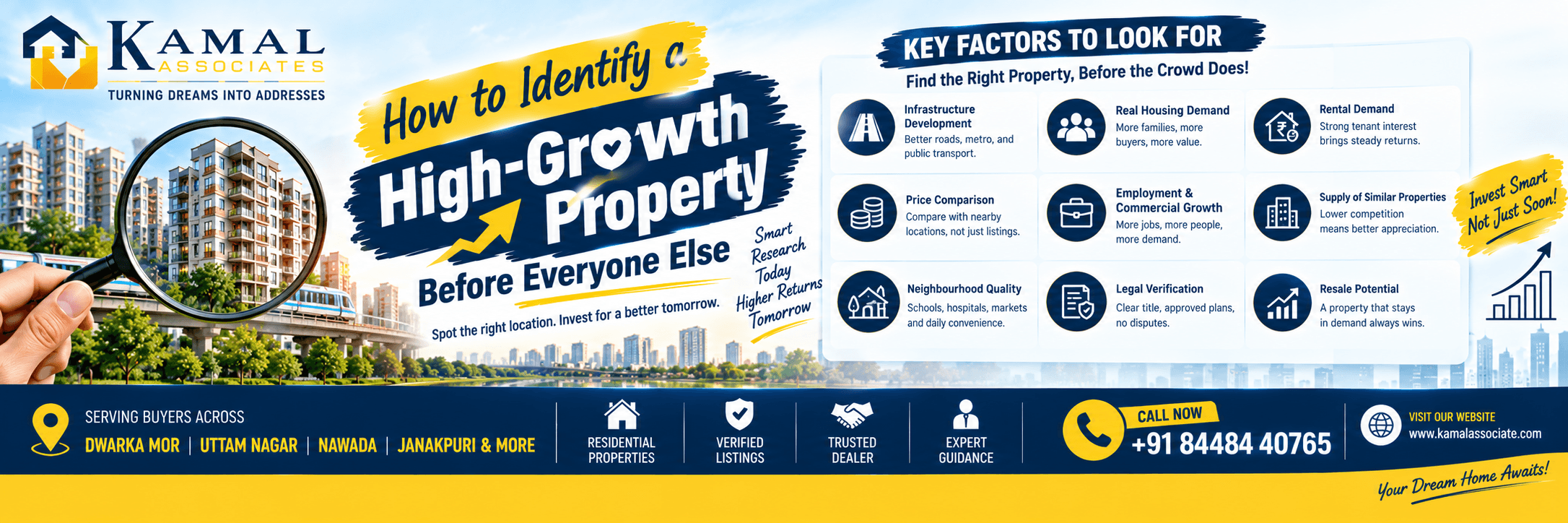
Buying a property is not just about finding a house at an attractive price. For investors, the real opportunity lies in identifying a property or locality that may experience stronger demand, improved connectivity, and better resale prospects in the future.
In Delhi and West Delhi, buyers often compare residential properties in Dwarka Mor, Nawada, Uttam Nagar, Janakpuri, and nearby areas. But how can you identify a promising property before it becomes popular and attracts more buyers?
The answer is to look beyond advertisements, property prices, and investment promises. You need to understand the factors that create genuine demand and verify whether those factors are already developing in a particular location.
According to real estate guidance published by India Today, infrastructure progress, employment opportunities, developer activity, and actual housing demand can provide useful signals when evaluating emerging locations.
In this guide, Kamal Associates explains how to identify a potentially high-growth property before it becomes a popular investment choice.
1. Look for Infrastructure Development Before Prices Rise
Infrastructure is one of the most important factors to investigate when evaluating a property's growth potential. Better roads, improved public transport, reliable utilities, and access to commercial areas can make a locality more attractive to residents and investors.
However, the key is to distinguish between infrastructure that is operational, infrastructure under construction, approved projects, and projects that have merely been announced.
For example, an improvement in road connectivity may make daily commuting easier. A verified transport project may also improve access to employment centres and essential services.
What should you check?
Current road conditions and traffic movement.
Distance and actual travel time to metro stations.
Officially approved infrastructure projects.
Construction progress and published project timelines.
Access to schools, hospitals, markets, and workplaces.
Always verify project information through the relevant government department or infrastructure authority. Do not purchase a property solely because a broker claims that a new metro station, expressway, or flyover will arrive nearby.
2. Identify Areas Where Real Housing Demand Is Growing
A location can look promising on paper but still perform poorly if people do not want to live there.
One of the strongest indicators to investigate is genuine housing demand. Are families moving into the neighbourhood? Are tenants searching for homes? Are completed properties occupied? Are comparable properties actually being sold?
These questions help distinguish a developing residential market from a location driven mainly by speculation.
Signs worth monitoring
Increasing occupancy in residential buildings.
Regular rental enquiries and completed rental agreements.
Consistent buyer interest in comparable properties.
Shops and everyday services opening in the neighbourhood.
Evidence of completed property transactions.
For instance, if a locality has several attractive properties but many remain vacant, investigate why. Strong marketing activity alone does not prove that a market is growing sustainably.
3. Study Rental Demand Before Investing
Rental demand can provide useful evidence of a property's practical value. Areas that offer convenient transport, access to employment, and essential facilities may appeal to tenants who want to reduce commuting time.
A property with a realistic rental market can also provide income while the owner holds it for the long term.
However, a high advertised rent does not necessarily mean the property will earn that amount consistently.
How to evaluate rental potential
Research the actual rents of similar properties in the same locality. Compare the property's size, furnishing, building condition, parking, and distance from transport facilities.
Calculate the gross rental yield using this formula:
Gross rental yield = Annual rental income ÷ Total property purchase price × 100
For example, if a property costs ₹50 lakh and earns ₹15,000 per month in rent:
Annual rent: ₹1,80,000
Purchase price: ₹50,00,000
Gross rental yield: 3.6% per year
This is only a simplified example. Net returns will be lower after maintenance, vacancy periods, repairs, taxes, and other applicable expenses.
4. Compare Property Prices With Nearby Locations
An emerging location may offer opportunities when its fundamentals are improving but its property prices have not fully reflected those improvements.
However, a cheaper property is not automatically undervalued. Lower prices may reflect weaker demand, poor connectivity, legal complications, construction problems, or limited resale opportunities.
Use a practical comparison method
Compare similar properties across two or three nearby localities. Consider:
Price per square foot or square yard, using consistent measurements.
Property age and construction quality.
Number of bedrooms and usable space.
Access to transport and essential services.
Recent comparable transactions, where reliable data is available.
Current rental values and resale demand.
Avoid comparing a newly constructed premium property with an older builder floor and assuming that the price difference represents future appreciation.
For a more reliable assessment, use comparable properties with similar specifications and verify transaction information wherever possible.
5. Watch for Employment and Commercial Development
Residential demand often follows employment opportunities. When businesses expand or new commercial centres become operational, nearby locations may attract people looking for convenient housing.
This does not mean that every new commercial project will increase nearby property prices. The impact depends on the number of jobs created, commuting options, the type of workforce, and the availability of competing housing.
What to investigate
Existing employment centres and business districts.
Commercial projects with verifiable development progress.
Travel times between the property and major workplaces.
Local businesses and services supporting residents.
Whether housing options meet the needs of likely tenants and buyers.
A location supported by multiple employment sources may have a broader demand base than one dependent on a single proposed development.
6. Check the Supply of Similar Properties
Investors often focus on demand but overlook supply. Even when a location attracts buyers, an excessive number of similar properties can create competition.
For example, if many similar 2BHK flats are available for sale or rent in the same neighbourhood, owners may need to offer lower prices or rents to attract customers.
Questions to ask
How many comparable properties are currently listed?
Are completed properties occupied?
How much similar housing is under construction?
Are properties selling, or are listings remaining active for long periods?
Is demand keeping pace with the available supply?
Do not treat the number of online listings as a complete picture of the market. Listings may be duplicated or outdated, so verify details with multiple sources and local market participants.
7. Evaluate the Neighbourhood, Not Just the Property
A property can be well designed but still have limited appeal if the surrounding neighbourhood is inconvenient or poorly maintained.
Daily liveability plays an important role in attracting families and tenants. Buyers often consider access to schools, healthcare, markets, public transport, parking, and basic civic facilities.
Visit the area personally
Visit at different times of day to observe traffic, noise, road access, street lighting, and general activity. Ask residents about water supply, drainage, maintenance, and recurring local problems.
Check whether the property's location works for your own needs and the needs of likely future buyers.
For residential properties in West Delhi, compare the actual convenience of the street and neighbourhood rather than relying only on a locality's name or its distance from a major landmark.
8. Verify Legal Documents and Construction Quality
Growth potential is irrelevant if a property has serious legal or construction problems. A promising location cannot compensate for an unclear title, unauthorised construction, or unresolved ownership disputes.
Before making a commitment, arrange appropriate legal and technical checks.
Depending on the property, these may include:
Seller identity and legal authority to sell.
Title documents and previous ownership records.
Applicable building approvals and land-use requirements.
Relevant mortgage, encumbrance, and litigation checks.
Outstanding property dues.
Construction quality, visible defects, and maintenance needs.
Applicable project registration and completion documents, where required.
Consult a qualified property lawyer and, where appropriate, a technical professional. Never assume that a registered document or home loan approval automatically eliminates every possible risk.
9. Look for Properties With Strong Resale Potential
A property may offer attractive features but still be difficult to sell later. Resale potential depends partly on how many people may want to buy that type of home in the future.
Properties with practical layouts, convenient access, good maintenance, clear documentation, and reasonable pricing may appeal to a wider group of buyers.
Consider the future buyer
Ask yourself who is most likely to purchase the property from you.
Would it suit a small family, a working professional, or a larger household? Is the layout practical? Are the maintenance costs manageable? Is parking available if buyers in that market typically expect it?
A property that meets everyday needs and remains affordable to its target audience may have better resale prospects than one purchased purely for its unusual features.
10. Use a Simple High-Growth Property Scorecard
Before choosing an investment, compare shortlisted properties using the same criteria. The following scorecard can help organise your research.
Give each factor a score from 1 to 5, where 1 means weak and 5 means strong.
FactorScoreCurrent connectivity/5Verified infrastructure progress/5Actual buyer and rental demand/5Price compared with similar properties/5Neighbourhood facilities/5Construction quality/5Legal clarity/5Resale potential/5
Use the scorecard to compare properties, not to guarantee future returns. Legal clarity should be treated as a basic requirement, not something that can be compensated for by a high score in another category.
A property with a low price but weak demand, poor access, and unresolved legal concerns should not automatically be considered a good opportunity.
Common Mistakes to Avoid When Searching for High-Growth Properties
Even experienced buyers can make mistakes when they become overly focused on future appreciation.
Avoid these common errors:
Following hype: Do not buy just because an area is trending online.
Trusting every infrastructure announcement: Verify approvals, funding, and actual progress.
Ignoring rental demand: Understand who will live in the property and what they will pay.
Overlooking competing supply: Too many similar properties can affect rents and resale prospects.
Paying too much upfront: Compare prices and negotiate using relevant evidence.
Skipping legal checks: Verify documents before committing significant money.
Expecting guaranteed returns: Property values can stagnate or decline, and resale can take time.
The goal is not to predict the exact location that will become popular next. It is to identify places where several positive factors are developing together while carefully assessing the risks.
Conclusion: Identify the Fundamentals Before the Crowd Arrives
Identifying a high-growth property before everyone else requires research, patience, and realistic expectations. Strong connectivity, employment opportunities, genuine housing demand, sensible pricing, manageable supply, and neighbourhood development can all help you evaluate a property's future potential.
But no single factor guarantees appreciation. A proposed infrastructure project may be delayed, demand may weaken, or a property may already be overpriced.
Whether you are considering a 2BHK flat, a 3BHK builder floor, or another residential investment in West Delhi, compare multiple options, visit the location, check reliable market evidence, and complete the necessary legal verification.
Looking for residential property in West Delhi?
Kamal Associates can help you explore available property options in Dwarka Mor, Uttam Nagar, Nawada, Janakpuri, and nearby areas according to your budget and requirements.
Website: https://www.kamalassociate.com/
Call: +91 84484 40765
Related Articles

10 Property Buying Mistakes That Can Cost You Lakhs
Avoid 10 common property buying mistakes that can cost you lakhs. Learn about legal verification, hidden costs, home loans, property inspection, and smart buying tips in Delhi.

The Biggest Myths About Buying Property in Delhi
Discover the biggest myths about buying property in Delhi. Learn about hidden costs, legal verification, home loans, property prices, and smart buying tips for West Delhi.
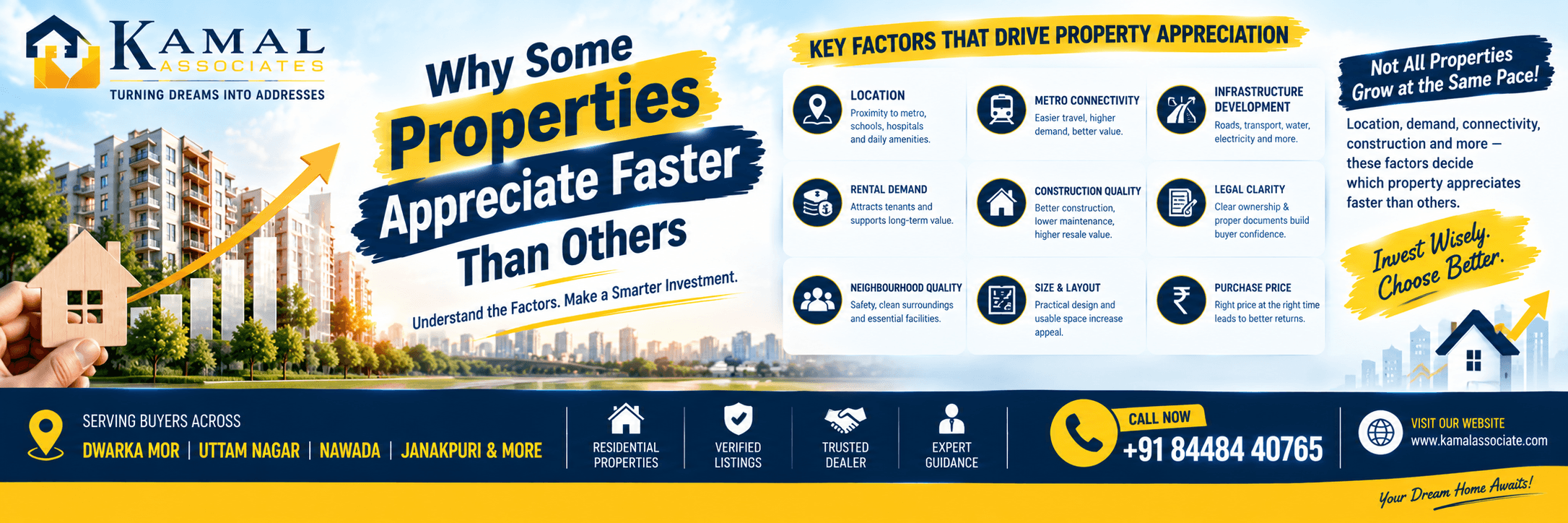
Why Some Properties Appreciate Faster Than Others
Discover why some properties appreciate faster than others. Learn how location, metro connectivity, infrastructure, rental demand, and legal verification affect property value in West Delhi.