How Wide Roads Affect Property Prices
Discover how road width affects property prices, accessibility, resale value, parking, connectivity and investment potential in West Delhi.
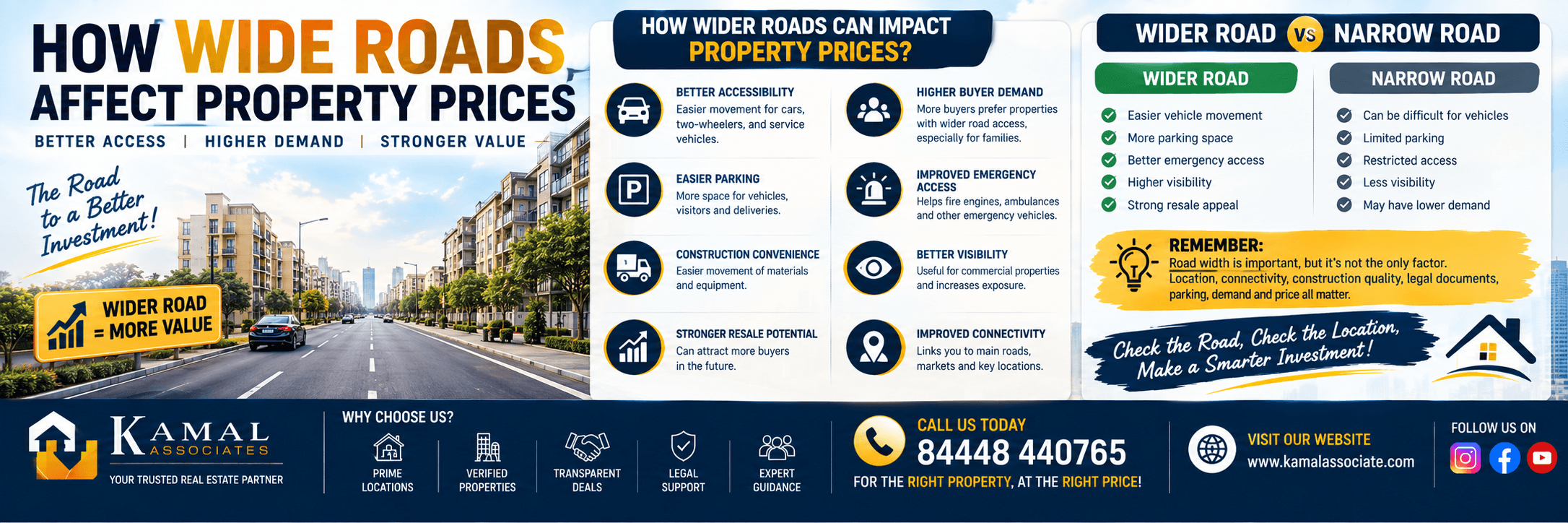
When buyers compare two properties in the same locality, they usually look at price, size, floor, construction quality, location and amenities. One important factor that often gets overlooked is the width of the road in front of the property.
A property located on a wider road can offer better vehicle movement, easier access, improved visibility and, in some cases, stronger buyer demand. But a wider road does not automatically mean a higher property price. The actual impact depends on location, connectivity, surrounding development, property type and whether the road provides a genuine practical advantage.
Research on urban property valuation has found that wider roads can contribute to higher land rates because of better access and amenities, although some buyers may prefer quieter properties away from busy roads.
For buyers looking at Dwarka Mor, Uttam Nagar, Nawada, Nangli and other parts of West Delhi, understanding this factor can help when comparing similar properties.
What Does Road Width Mean in Real Estate?
Road width simply refers to the approximate width of the road providing access to the property.
For example, you may find properties on:
10–12 ft roads
15–20 ft roads
20–30 ft roads
30–40 ft roads
Wider main roads
The practical importance of each road depends on the neighbourhood and the type of property.
A road isn't valuable simply because it is wide. What matters is how that road connects the property to the rest of the area.
A 30-ft internal road with poor connectivity may be less useful than a reasonably wide road that connects directly to an important local route.
1. Wider Roads Can Improve Accessibility
One of the biggest advantages of a wider road is easier access.
A wider road can make it more convenient for:
Cars
Two-wheelers
Delivery vehicles
Visitors
Service providers
Emergency vehicles
Construction vehicles
For families purchasing a home, daily accessibility matters.
Imagine having to bring your car into a very narrow lane every day. Parking, turning and passing another vehicle can become difficult.
A wider approach road can reduce some of these practical problems.
2. Road Width Can Influence Buyer Demand
Property value is strongly connected with demand.
When two properties are otherwise similar, some buyers may prefer the property with better road access.
This can become particularly relevant during resale.
A future buyer may ask:
"Can my car easily reach the property?"
"Can two vehicles pass comfortably?"
"Is parking easy?"
"Can visitors reach the house without difficulty?"
These questions can influence the buyer's perception of the property.
Research on property valuation also identifies road access and connectivity as factors that can influence land values.
3. Wide Roads Can Make Parking Easier
Parking is an important consideration in densely populated residential areas.
When a property is located on a wider road, there may be more practical space for:
Vehicle entry and exit
Temporary parking
Visitor access
Loading and unloading
Turning vehicles
However, buyers should not assume that a wider public road automatically gives them a legal right to use the road as private parking.
Road width and parking rights are two different things.
Always verify the actual parking arrangement mentioned in the property documents or sale agreement.
4. Wide Roads Can Improve Emergency Access
Road accessibility can also matter for emergency situations.
Fire engines, ambulances and other emergency vehicles require sufficient access to reach residential buildings.
This becomes especially important for:
Multi-storey buildings
Builder floors
Apartment buildings
Larger residential developments
The exact access requirements depend on the applicable building and fire-safety rules.
Therefore, buyers should not only ask "How wide is the road?" but also whether the property and building comply with applicable requirements.
5. Road Width Can Affect Construction Convenience
For buyers purchasing plots, independent houses or properties under construction, road access can have another advantage.
Construction often requires movement of:
Cement
Steel
Bricks
Sand
Furniture
Equipment
Construction vehicles
A narrow lane can make movement and delivery more difficult.
A better-access road may therefore provide practical benefits during construction or renovation.
6. Wider Roads Can Increase Property Visibility
Road width becomes even more important when a property has a commercial or mixed-use component.
A property on a wider road may have:
Better visibility
Easier customer access
More passing traffic
Better signage opportunities
Greater commercial exposure
This is one reason properties facing major roads can sometimes command higher prices.
However, residential buyers should be careful: high traffic isn't always an advantage.
A busy road can also bring:
Noise
Dust
Traffic congestion
Reduced privacy
Safety concerns
Official DDA planning guidance, for example, distinguishes permitted activities by road width and land-use context, showing that road width can interact with how property is used.
7. Road Width Can Affect Resale Potential
Let's consider two similar builder floors:
Property A
Similar size
Similar construction
Same locality
Narrow internal road
Property B
Similar size
Similar construction
Same locality
Better road access
If other factors are comparable, Property B may attract buyers who place greater value on accessibility.
This does not mean Property B will always sell for more.
Resale value depends on many factors, including:
Location
Demand
Connectivity
Property condition
Documentation
Parking
Floor
Layout
Local infrastructure
Market conditions
Road width is one part of the overall valuation.
8. Location Still Matters More Than Road Width Alone
One of the biggest mistakes buyers make is thinking:
"Wider road = better property."
It isn't that simple.
Consider two properties:
Property A: 40-ft road but far from metro, markets and important routes.
Property B: 20-ft road but excellent connectivity, nearby metro, schools, markets and strong residential demand.
A buyer may value Property B more despite the narrower road.
Property valuation research also shows that accessibility, infrastructure and surrounding urban characteristics interact in determining land values.
So always evaluate the complete location, not just the road.
9. Main Road vs Internal Road
There is an important difference between a wide internal road and a busy main road.
Wide Internal Road
Advantages may include:
Easier vehicle movement
Better residential accessibility
Less congestion
Comfortable approach
Busy Main Road
Advantages may include:
High visibility
Strong connectivity
Commercial potential
Easy access to transport
Possible disadvantages include:
Traffic noise
Pollution
Congestion
Less privacy
Pedestrian movement
Therefore, a residential buyer should not automatically pay a premium simply because the property faces a major road.
10. Road Width Can Influence Land Value
Urban valuation literature recognises road width as one factor that can affect land rates.
A government-hosted valuation text notes that wider roads can provide better amenities and therefore support higher land rates in comparable neighbourhoods. It also points out that buyers in some important residential areas may prefer quieter locations away from wider roads because of traffic and noise.
This is an important distinction:
Road width can influence value, but the relationship isn't universal.
The same road width can have different effects in different neighbourhoods.
11. Future Road Development Can Change Property Demand
Road infrastructure can also change the attractiveness of an area over time.
When new roads or better connections improve accessibility to employment centres, markets and transport networks, demand for nearby property can change.
Studies of Indian real estate have found links between improved transport connectivity and residential property values, although the impact varies by micro-market and other local factors.
This means buyers should consider:
Current road access + future connectivity.
But be careful with claims about proposed roads.
Don't pay a premium based only on a broker's statement that:
"A very wide road is coming here."
Verify the project through the relevant government or planning authority before treating it as a factor in your investment decision.
12. Don't Confuse Advertised Road Width With Actual Access
This is a very important point for buyers.
A property advertisement may mention:
"30-ft road"
or
"40-ft approach road."
But buyers should verify the actual situation on the ground.
A 2026 report on Gurgaon highlighted cases where advertised 24-metre approach roads were incomplete, narrow at certain stretches or affected by land-acquisition and access issues.
The lesson for buyers is simple:
Don't verify the road only from the brochure.
Visit the property and check:
Actual road width
Road condition
Complete approach route
Any bottlenecks
Encroachments
Parking obstruction
Connection to the main road
13. Measure the Road Before Paying a Premium
If road width is an important reason for choosing one property over another, verify it.
You can:
Ask the seller for property/site documents.
Check available layout or approved plans.
Visit the location personally.
Compare the road with neighbouring streets.
Check the complete access route.
Ask a property professional or surveyor where necessary.
Don't base a major price decision on a number mentioned verbally.
14. Wide Road Does Not Mean You Should Overpay
Suppose two similar properties are available:
Property A
Price: ₹50 lakh
Road: 20 ft
Property B
Price: ₹58 lakh
Road: 30 ft
The question shouldn't simply be:
"Which road is wider?"
Instead ask:
"Does the additional road width justify the ₹8 lakh premium?"
Compare:
Location
Metro distance
Property size
Construction quality
Parking
Floor
Facing
Documentation
Rental demand
Resale demand
Surrounding infrastructure
This gives you a more realistic picture of value.
15. Road Width and Dwarka Mor Property
In areas such as Dwarka Mor and surrounding West Delhi neighbourhoods, buyers often compare properties located on different streets and lanes.
When comparing properties, don't look only at the distance from the metro.
Also check the last-mile approach.
A property may be close to a metro station but have a difficult final approach.
Another property may be slightly farther away but have:
Better road access
Easier vehicle movement
Better parking
Wider approach
Better neighbourhood planning
This is why micro-location matters.
16. A Simple Property Comparison Formula
When comparing two properties, consider these factors:
Location
Is it close to important destinations?
Connectivity
How easily can you reach major roads and transport?
Road Width
Is the approach practical for everyday use?
Property Quality
Is the construction reliable?
Parking
Is parking actually available and documented?
Legal Documentation
Is the property legally verified?
Demand
Are buyers and tenants interested in this micro-location?
Price
Is the asking price reasonable compared with similar properties?
Future Potential
Could infrastructure and development improve the area?
This approach is more useful than judging a property on road width alone.
17. Wide Road vs Narrow Road: Quick Comparison
FactorWider RoadNarrow RoadVehicle movementGenerally easierCan be difficultParking accessOften more convenientMay be challengingEmergency accessPotentially betterCan be restrictedConstruction accessGenerally easierMay be difficultVisibilityUsually higherUsually lowerTrafficCan be higherOften lowerNoiseCan be higherOften lowerPrivacyMay be lowerCan be betterCommercial potentialOften strongerUsually lowerResale appealCan help in comparable propertiesDepends strongly on location
The key point is that neither option is automatically better for every buyer.
18. Questions to Ask Before Buying
Before purchasing a property, ask:
1. What is the actual road width?
2. Is the road officially part of the planned/access network?
3. Is the entire approach road equally wide?
4. Is there any bottleneck before reaching the property?
5. Can cars enter and exit comfortably?
6. Is parking legally available?
7. Is the property residential or mixed-use as permitted?
8. Are there any encroachments?
9. Is the road likely to be widened or affected by future development?
10. Is the property's price premium justified by the road advantage?
Final Thoughts
Road width is an important but often overlooked factor in property valuation.
A wider road can improve accessibility, vehicle movement, construction convenience, visibility and buyer appeal. These advantages can contribute to stronger demand when other property factors are comparable.
However, road width should never be considered in isolation.
A smart buyer should evaluate:
Location + Connectivity + Road Width + Property Quality + Legal Documents + Parking + Demand + Price
Together, these factors provide a much clearer picture of whether a property is genuinely worth its asking price.
For buyers searching for 2BHK, 3BHK and builder-floor properties in Dwarka Mor, Uttam Nagar, Nawada and nearby West Delhi areas, checking the actual road access during a site visit can be just as important as checking the property itself.
Kamal Associates can help buyers explore residential properties and compare important factors such as location, connectivity, property type and overall suitability.
Disclaimer: Property prices and market demand vary by locality and time. Road width alone does not guarantee appreciation or a particular resale price. Buyers should independently verify property documents, access rights and applicable approvals before making a purchase.
Related Articles

Top Legal Checks Every Home Buyer Must Complete Before Buying Property
Learn the essential legal checks before buying a home, including title verification, ownership, encumbrances, property documents, approvals and registration.

What Makes a Property a Smart Long-Term Investment?
Discover what makes a property a smart long-term investment, from location and connectivity to rental demand, resale value, documentation and affordability.

Why Verified Properties Always Sell Faster
Discover why verified properties can attract serious buyers faster. Learn how clear documents, ownership verification, fair pricing and transparency make property transactions easier.