Top Legal Checks Every Home Buyer Must Complete Before Buying Property
Learn the essential legal checks before buying a home, including title verification, ownership, encumbrances, property documents, approvals and registration.
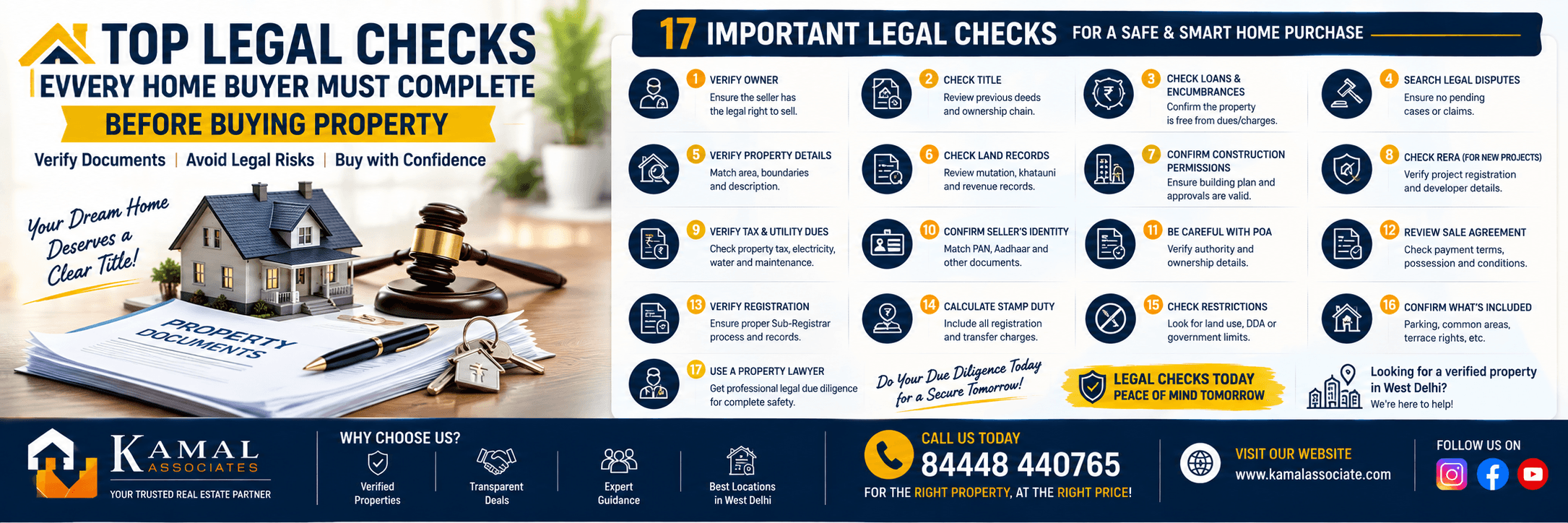
Buying a home is one of the biggest financial decisions most people make. While buyers usually focus on price, location, size, interiors and loan availability, the legal side of a property is equally important.
A property may look perfect on the outside, but problems related to ownership, title, encumbrances, approvals, land records, construction permissions or pending disputes can create serious complications later.
For buyers in West Delhi, Dwarka Mor, Uttam Nagar, Nawada, Nangli and nearby areas, completing proper legal verification before paying a large amount or signing the final agreement can help reduce avoidable risks.
Delhi's Revenue Department provides facilities for searching registration records, encumbrances, land records and property-related information.
Here are the most important legal checks every home buyer should complete.
1. Verify the Property Owner
The first question should be simple:
Does the person selling the property actually have the legal right to sell it?
Ask the seller for the relevant ownership documents and compare the owner's:
Full name
Property address
Property number
Khasra/plot details, where applicable
Area and boundaries
Previous ownership details
Do not rely only on the seller's verbal statement.
The ownership information should match across the available documents and government records.
Delhi's land-record system contains information such as ownership-related records, mutation and other land details.
2. Check the Title of the Property
Title verification is one of the most important legal checks.
A title check looks at how ownership of the property has passed from previous owners to the current owner.
Depending on the property, you may need to examine documents such as:
Previous sale deeds
Conveyance deed
Gift deed
Partition deed
Relinquishment deed
Inheritance documents
Mutation records
Other relevant title documents
The objective is to establish a clear chain of ownership.
Why is this important?
If there is a break or inconsistency in the ownership chain, it can create problems during:
Registration
Bank loan processing
Resale
Property disputes
Inheritance claims
For complicated properties, have the title documents reviewed by a qualified property lawyer.
3. Check for Existing Loans or Encumbrances
A property may have an existing:
Bank mortgage
Loan
Charge
Legal claim
Court-related restriction
Other encumbrance
This is why buyers should check whether the property is free from known encumbrances before completing the transaction.
Delhi's official property-registration information specifically provides options for encumbrance searches, and the Delhi Property Information System also provides property-related information concerning encumbrances and disputes.
Ask for supporting documents
Depending on the situation, this may include:
Loan closure documents
Bank NOC
Release deed
Encumbrance-related records
Relevant court/revenue records
Do not assume that a seller saying "there is no loan" is sufficient verification.
4. Search for Pending Legal Disputes
A property can sometimes be involved in a dispute even when it is physically occupied and appears normal.
Check for possible disputes involving:
Ownership
Inheritance
Boundary
Possession
Family claims
Recovery proceedings
Revenue matters
Court cases
Delhi's property information system states that it integrates information relating to property encumbrances, dispute/court cases and registered owners.
For a significant purchase, a lawyer can also conduct a broader legal due-diligence search based on the property's documents and circumstances.
5. Verify the Property Description
The property described in the documents should match the property you are actually purchasing.
Check:
Plot/house number
Floor number
Built-up area
Carpet area, where applicable
Land area
Boundaries
Road details
Locality
Khasra number, where applicable
Parking details
Terrace rights, if applicable
The Delhi Property Information System notes that property documents should contain a full description sufficient to identify the property, including relevant survey/house/locality and boundary details.
Why does this matter?
Imagine you are buying a builder floor advertised as having a particular area and parking space.
If the agreement does not properly describe what you are purchasing, disagreements can arise later.
6. Check Mutation and Land Records
Mutation is an important record-related check, particularly for properties where land or ownership records are relevant.
Review available:
Mutation records
Khatauni
Khasra details
Jamabandi, where applicable
Revenue records
Land-use-related records
Delhi's official land-record system provides access to information such as Khasra, Khatauni, Jamabandi and GIS map information.
Remember that a mutation entry by itself should not be treated as a substitute for complete title verification.
7. Verify Building and Construction Permissions
Buying a property is not only about the land title.
You should also investigate whether the existing construction is permitted and whether the property matches the approved or legally permissible structure.
Depending on the property, check relevant:
Building plan
Construction permissions
Completion/occupancy-related documents
Local authority approvals
Floor-related permissions
Layout details
This becomes particularly important when purchasing:
Builder floors
Independent houses
Newly constructed properties
Properties with additional floors
Properties with significant alterations
A lawyer or qualified property professional can help determine which approvals are relevant to the specific property.
8. Check RERA Applicability for New Projects
If you are buying from a developer in a project covered by the Real Estate (Regulation and Development) Act, check the project's RERA registration and project details.
Verify information such as:
Project registration
Promoter details
Approved project information
Completion timeline
Available units
Declared project details
Do not assume that every property transaction falls under exactly the same RERA requirements. The applicability depends on the nature of the project and transaction.
9. Verify Property Tax and Utility Dues
Before completing the purchase, check whether outstanding dues are associated with the property.
Depending on the property, investigate:
Property tax
Electricity bills
Water bills
Maintenance charges
Other applicable local dues
Delhi's Revenue Department specifically lists checks involving water bills, electricity-related records, property tax and other records when assessing non-encumbrance information.
Important tip
Ask for recent paid receipts instead of accepting only a verbal confirmation that everything has been paid.
10. Check the Seller's Identity
Before signing documents, verify the seller's identity carefully.
Compare the details in:
PAN
Aadhaar/other valid ID
Sale documents
Bank details where relevant
Ownership documents
The name should be consistent across the transaction documents, subject to legitimate differences that may need supporting documentation.
If someone is selling the property on behalf of the owner, additional verification becomes especially important.
11. Be Careful With Power of Attorney Transactions
Some properties are offered through a Power of Attorney (POA) arrangement.
Do not automatically assume that a POA means the person holding it owns the property.
You should verify:
Who is the actual owner?
What authority does the POA provide?
Is the POA valid and applicable to the transaction?
What documents establish ownership?
Is the proposed transaction legally registrable?
Delhi's official property-registration guidance distinguishes between ownership documents and Power of Attorney and provides specific registration information.
For a POA-based transaction, professional legal review is particularly advisable.
12. Check the Sale Agreement Before Paying a Large Amount
The agreement should clearly mention the important commercial and property details.
Check:
Total purchase price
Token amount
Payment schedule
Property description
Possession date
Included fixtures
Parking rights
Default conditions
Cancellation terms
Existing liabilities
Responsibility for outstanding dues
Registration responsibilities
Don't sign a blank document
Never sign an incomplete agreement with the expectation that the remaining details will be filled in later.
Read every page before signing.
13. Verify Registration Details
A registered sale transaction should be handled through the appropriate Sub-Registrar process.
Delhi's Revenue Department states that property documents are registered under the Registration Act, 1908, and that the relevant Sub-Registrar office depends on the jurisdiction in which the property is situated.
The official Delhi system also provides facilities for searching registration records.
This is useful when reviewing the property's registration history.
14. Check Stamp Duty and Registration Costs
The property's purchase price is not always the complete transaction cost.
Buyers should account for applicable:
Stamp duty
Registration fee
Transfer-related charges where applicable
Legal/documentation costs
Other transaction expenses
Delhi's Revenue Department currently publishes information on stamp duty, registration fees and applicable valuation/circle-rate procedures.
Before making the final payment, calculate the complete expected transaction cost.
15. Check Whether the Property Has Any Restrictions
Some properties can have specific restrictions or special conditions relating to:
Land use
Government acquisition
Leasehold status
DDA-related matters
Agricultural land
Prohibited properties
Construction restrictions
Local planning rules
Delhi's Revenue Department provides access to resources including land records, prohibited-property information, circle rates and other property-registration resources.
If a property has an unusual ownership or land status, get professional verification before proceeding.
16. Verify What Exactly Comes With the Property
Legal verification should also cover what you are actually buying.
For example:
Apartment
Check:
Flat number
Floor
Parking
Common areas
Proportionate land/rights where applicable
Possession status
Builder Floor
Check:
Floor ownership
Land share/rights
Parking
Terrace rights
Common staircase/access
Construction permissions
Independent House
Check:
Land title
Built-up structure
Plot boundaries
Construction permissions
Utility connections
Never assume that a feature shown in a property advertisement automatically becomes part of your legal ownership.
17. Use a Property Lawyer for Final Due Diligence
Online searches and document checks are useful, but they should not replace professional legal review for a significant purchase.
A property lawyer can help examine:
Title chain
Sale deeds
Encumbrances
Court/revenue issues
Agreements
Ownership claims
Construction-related documents
Registration documents
This is especially important when the property has:
Multiple previous owners
Inheritance history
POA involvement
Unusual documentation
Multiple floors
Existing disputes
Old or incomplete records
Complete Home Buyer's Legal Checklist
Before making the final payment, try to confirm:
✅ Seller's identity verified
✅ Ownership verified
✅ Title chain checked
✅ Previous sale deeds reviewed
✅ Encumbrance search completed
✅ Pending disputes checked
✅ Land records reviewed
✅ Mutation checked where applicable
✅ Property boundaries verified
✅ Construction permissions checked
✅ RERA checked where applicable
✅ Property tax checked
✅ Electricity/water dues checked
✅ Loan/mortgage status verified
✅ Sale agreement reviewed
✅ Parking and other rights clearly documented
✅ Stamp duty calculated
✅ Registration requirements confirmed
✅ Final legal opinion obtained where necessary
Final Thoughts
Buying a home should not be based only on price, location and appearance.
A property can look attractive today, but its long-term value and usability also depend on the quality of its documentation and legal status.
The most important principle is simple:
Verify first. Pay later.
Take time to check the title, ownership, encumbrances, disputes, land records, construction permissions, dues and registration documents before committing a substantial amount of money.
For properties in Dwarka Mor, Uttam Nagar, Nawada, Nangli and other West Delhi locations, buyers should evaluate both the property itself and the documentation supporting the transaction.
Kamal Associates can help buyers explore residential properties and understand the documentation and transaction process. For complex legal matters, buyers should consult a qualified property lawyer.
Disclaimer: This article is for general informational purposes and should not be treated as legal advice. Property laws, documents and requirements can vary by property and transaction. Obtain professional legal verification before purchasing.
Related Articles

What Makes a Property a Smart Long-Term Investment?
Discover what makes a property a smart long-term investment, from location and connectivity to rental demand, resale value, documentation and affordability.

Why Verified Properties Always Sell Faster
Discover why verified properties can attract serious buyers faster. Learn how clear documents, ownership verification, fair pricing and transparency make property transactions easier.

How Infrastructure Projects Increase Property Value
Learn how metro, roads, transport and infrastructure projects can impact property value, rental demand and resale potential in West Delhi.