What Makes a Property a Smart Long-Term Investment?
Discover what makes a property a smart long-term investment, from location and connectivity to rental demand, resale value, documentation and affordability.

Buying property is not simply about finding a beautiful home at an attractive price. For a long-term investor, the bigger question is:
"Will this property continue to be valuable and desirable 5, 10 or even 15 years from now?"
A smart property investment should ideally combine location, connectivity, demand, property quality, legal clarity, rental potential and financial affordability.
Current real-estate commentary in India also highlights that long-term value depends on more than short-term rental yield or infrastructure announcements. Location, employment hubs, connectivity, social infrastructure, liveability and sustained demand all play a role.
For buyers considering West Delhi property, including 2BHK and 3BHK homes in Dwarka Mor and nearby areas, these factors can help in evaluating whether a property has strong long-term fundamentals.
1. Location Is the Foundation
The first rule of long-term property investment is simple:
You can renovate a property, but you cannot change its location.
A good location can offer access to:
Metro connectivity
Main roads
Public transportation
Schools
Hospitals
Markets
Employment hubs
Commercial areas
Daily-use facilities
Properties in locations with strong connectivity and amenities can have broader buyer and tenant demand.
For this reason, don't choose a property only because the interiors look attractive.
Study the neighbourhood and surrounding ecosystem as carefully as you study the property itself.
2. Connectivity Creates Long-Term Demand
Connectivity is one of the most important factors when evaluating a property.
Think about your future buyer or tenant.
Would they prefer:
Property A: Beautiful interiors but difficult commuting
or
Property B: Good construction, practical interiors and easy access to metro and roads?
Many buyers will value convenience.
Better connectivity can support:
Homebuyer demand
Rental demand
Resale interest
Commercial activity
Accessibility
Recent real-estate analysis also points to transport connectivity and proximity to employment centres as important factors in long-term property demand.
3. Look for Real, Sustainable Demand
A smart investment needs buyers or tenants.
Before purchasing, ask:
"Who will want this property in the future?"
Potential demand can come from:
Families
Working professionals
Students
Local residents
Business owners
Investors
Tenants
A property in an area with a growing population and employment opportunities may have a larger potential customer base.
Don't simply invest because an area is currently popular.
Try to understand why people are choosing that area.
4. Employment Hubs Matter
People need homes close to their daily activities.
Employment centres can create housing demand because workers generally prefer manageable commutes.
When an area is connected to:
Offices
Business districts
Industrial areas
Commercial centres
Educational institutions
Healthcare facilities
it may benefit from stronger residential demand.
This can be especially relevant for investors looking for rental properties.
5. Metro Connectivity Can Add Convenience
Metro access can be a major advantage in Delhi NCR.
A well-connected property can appeal to buyers who want convenient access to different parts of the city.
However, don't simply believe a listing saying:
"5 minutes from Metro."
Check the actual route.
Consider:
Walking distance
Road crossings
Last-mile connectivity
Public transport
Traffic
Actual travel time
A practical location is more valuable than a marketing claim.
6. Infrastructure Is Important—but Don't Buy Only on Promises
Upcoming infrastructure can influence the future attractiveness of a locality.
Potential developments may include:
Metro expansion
Road improvements
Flyovers
Commercial centres
Hospitals
Schools
Public facilities
But there is a major difference between:
"Project announced"
and
"Project completed and operational."
Infrastructure can support real-estate growth, but it doesn't guarantee appreciation. Recent analysis also emphasises that connectivity alone isn't enough; liveability, social infrastructure, employment and overall ecosystem matter for sustained demand.
7. Property Quality Matters
Location may be extremely important, but the property itself still matters.
Check:
Construction quality
Layout
Natural light
Ventilation
Flooring
Plumbing
Electrical work
Water supply
Maintenance
Parking
Common areas
A property that is difficult to maintain may become less attractive over time.
A well-designed and properly maintained home can remain competitive when you eventually sell or rent it.
8. Choose a Practical Layout
A property doesn't need to be luxurious to be a smart investment.
It needs to be practical.
For example, a well-planned 2BHK can be attractive because it may suit:
Small families
Couples
Working professionals
First-time buyers
Rental tenants
When selecting a property, think about how easily another buyer could use the space.
Practical properties often have wider demand.
9. Rental Potential Can Support Your Investment
If you are buying an investment property, rental demand deserves attention.
Ask:
Who are the likely tenants?
What is the local rental range?
How many similar properties are available?
How long do properties typically remain vacant?
Is the location convenient for commuters?
Are employment or education hubs nearby?
Rental yield should not be the only metric. Recent investment guidance highlights that rental yield is useful but should be considered alongside location, infrastructure, tenant demand, quality and long-term appreciation potential.
10. Think About Resale Demand
A smart long-term investor should think like a future seller.
Imagine selling the property five or ten years from now.
What will the next buyer ask?
They may care about:
Location
Metro connectivity
Property condition
Parking
Documentation
Layout
Local development
Price
Rental potential
If the property appeals only to a very small group of buyers, resale may be more challenging.
A property with broader practical appeal may provide greater flexibility.
11. Legal Documentation Is Non-Negotiable
A property can have a great location and attractive price but still be a poor investment if its documentation creates significant uncertainty.
Before committing substantial money, buyers should verify relevant:
Ownership documents
Title records
Previous ownership chain
Applicable approvals
Property tax records
Existing loans or charges
Seller identity
Other transaction-specific documents
Legal requirements vary by property and transaction.
For complicated transactions, get the relevant documents reviewed by a qualified property lawyer.
12. Don't Ignore the Total Cost
The purchase price isn't always the complete cost of buying property.
Consider:
Stamp duty, where applicable
Registration charges
Brokerage
Loan-related costs
Maintenance
Renovation
Interiors
Parking
Moving expenses
Other applicable charges
A property that appears cheap initially may become expensive after adding all costs.
Always calculate the total investment—not just the advertised price.
13. Affordability Makes an Investment More Sustainable
A property can have excellent appreciation potential but still be a poor personal investment if the buyer is financially overstretched.
Before purchasing, consider:
Down payment
Monthly EMI
Interest cost
Maintenance
Emergency savings
Other financial commitments
Expected rental income, if applicable
Your property investment should remain manageable even if the market experiences a slower period.
14. Compare Price With Similar Properties
Never evaluate a property in isolation.
Compare similar properties in the same micro-market.
Look at:
FactorProperty AProperty BProperty CPrice₹X₹X₹XSize———Location———Floor———Parking———Construction———Metro Access———Documents———
This can help you determine whether you're paying a reasonable price.
15. Consider the Micro-Location
Two properties can be in the same locality but have very different investment potential.
For example:
Property A
Main-road access
Better parking
Convenient metro route
Nearby market
Property B
Narrow internal road
Difficult parking
Poor last-mile connectivity
Fewer nearby facilities
The locality name may be the same, but the actual experience can be very different.
Always inspect the exact location.
16. Look at the Neighbourhood, Not Just the Building
Your investment includes more than four walls.
Look around the property.
Check:
Road quality
Drainage
Street lighting
Nearby construction
Noise
Parking
Cleanliness
Water availability
Public transport
Local shops
A strong neighbourhood can support the property's long-term usability and marketability.
17. Don't Chase "Cheap" Property
The cheapest property is not always the smartest investment.
A low price may sometimes reflect:
Poor location
Weak demand
Construction issues
Limited accessibility
Documentation concerns
Poor resale prospects
Instead of asking:
"What is the cheapest property?"
ask:
"Which property gives me the best combination of price, quality, location and future demand?"
18. Think About Liquidity
Liquidity means how easily an asset can potentially be sold when you need to exit.
Real estate is generally less liquid than many financial assets.
Therefore, before investing, consider:
Number of potential buyers
Local demand
Property configuration
Price competitiveness
Location
Documentation
Overall market conditions
A property with a broad buyer base may be easier to sell than one designed for a very narrow audience.
19. Evaluate the Property From a 10-Year Perspective
One of the best ways to identify a long-term investment is to stop thinking only about today's market.
Ask:
In 5 years:
Will the location remain desirable?
In 10 years:
Will people still want to live here?
In the future:
Will connectivity and infrastructure improve?
At resale:
Will another buyer find this property practical?
These questions encourage you to focus on fundamentals instead of short-term excitement.
20. A Smart Property Has Multiple Strengths
The strongest long-term investments usually aren't dependent on one factor.
Instead, several factors work together:
Good Location
↓
Better Connectivity
↓
Strong Residential Demand
↓
Rental Potential
↓
Better Resale Appeal
This doesn't guarantee appreciation, but it creates a stronger investment case than relying on a single future promise.
Smart Long-Term Property Investment Checklist
Before buying, ask yourself:
☑ Is the location good?
☑ Is metro/public transport accessible?
☑ Are employment hubs nearby?
☑ Are schools and hospitals accessible?
☑ Is the neighbourhood developing sustainably?
☑ Is construction quality satisfactory?
☑ Is the layout practical?
☑ Is there genuine rental demand?
☑ Is the asking price reasonable?
☑ Have comparable properties been checked?
☑ Are the relevant documents clear?
☑ Have hidden costs been calculated?
☑ Is the EMI financially comfortable?
☑ Could the property attract future buyers?
☑ Would I still buy it if appreciation is slower than expected?
If most answers are positive, you may have a stronger foundation for your investment decision.
Final Thoughts
A smart long-term property investment isn't created by buying the most expensive home, the cheapest home or the property with the most luxurious interiors.
It comes from identifying strong fundamentals.
The ideal combination is:
Location + Connectivity + Demand + Quality + Documentation + Rental Potential + Resale Appeal + Financial Affordability
For buyers exploring West Delhi real estate, including 2BHK and 3BHK properties in Dwarka Mor and nearby areas, these factors can help you evaluate opportunities more carefully.
The most important question isn't:
"How much can this property increase?"
A better question is:
"What makes people want this property today—and what will make them want it tomorrow?"
That shift in thinking can help you make a more informed long-term property decision.
If you're looking for residential property in West Delhi, Kamal Associates can help you explore options according to your budget and requirements.
Website: https://www.kamalassociate.com/
Call: 84448 440765
Related Articles

Top Legal Checks Every Home Buyer Must Complete Before Buying Property
Learn the essential legal checks before buying a home, including title verification, ownership, encumbrances, property documents, approvals and registration.

Why Verified Properties Always Sell Faster
Discover why verified properties can attract serious buyers faster. Learn how clear documents, ownership verification, fair pricing and transparency make property transactions easier.
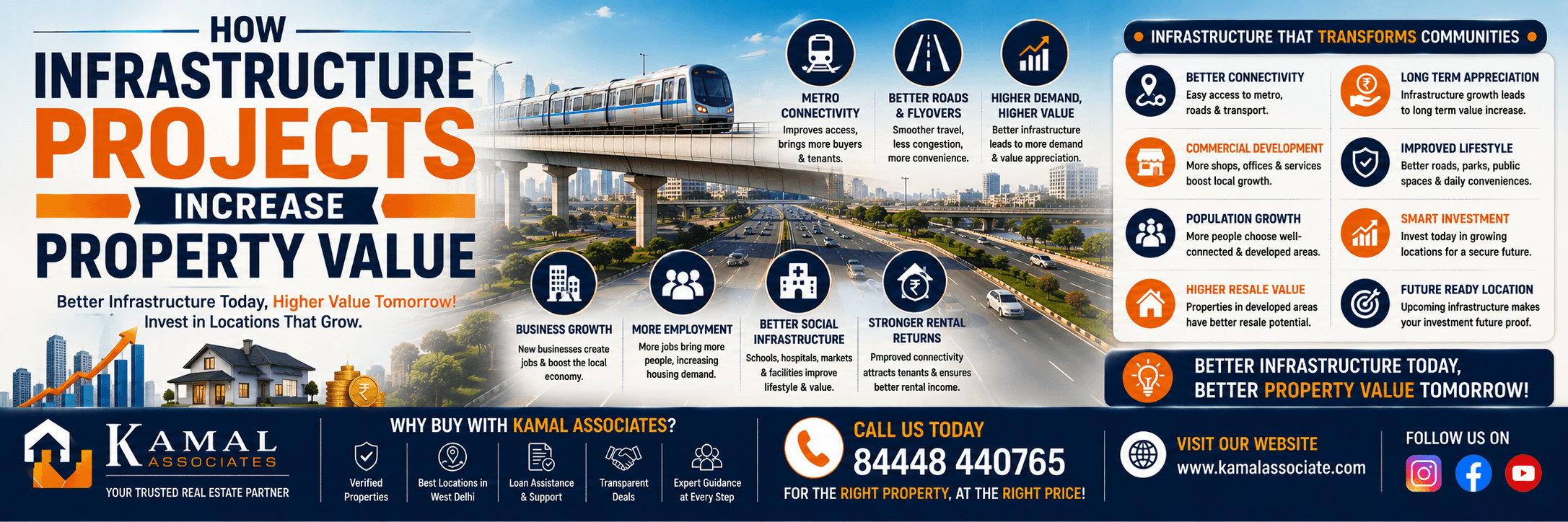
How Infrastructure Projects Increase Property Value
Learn how metro, roads, transport and infrastructure projects can impact property value, rental demand and resale potential in West Delhi.